


A world map for the wall is not only a decorative item, but also a personal travel journal that lets you visually preserve memories of the places you’ve visited. In the digital age, when photos often remain hidden in phone memory, a physical representation of our trips takes on special significance. In 2025, the trend of personalizing home spaces with elements that tell the owner’s story is becoming increasingly popular.
At Sikorka, for years we’ve been observing growing interest in products that combine decorative function with personal meaning. Our experience shows that travel-marking maps are becoming not just a keepsake, but also motivation to plan more trips.
Why it’s worth documenting your travels
Documenting trips is a practice dating back to the great explorers, who carefully recorded their observations and sketched maps of unknown lands. Today, travel documentation fulfills several important psychological and social functions.
Above all, preserving memories helps us hold on to fleeting moments and emotions. In addition, a visual presentation of the trips you’ve taken builds our identity as travelers and serves as an interesting element during social gatherings. Our customers often share stories about how a map becomes the focal point of conversations during home parties.
World map as a decorative element and a keepsake
Decorative world map is a two-in-one interior design element. On the one hand, it serves as an elegant and educational accent; on the other, it’s a personal artifact that tells the story of the residents. In 2025, it’s clearly evident that home spaces are being personalized with elements that carry deeper meaning beyond just aesthetic value.
According to the latest interior design trends, natural materials like wood remain consistently popular. Wooden maps made by Sikorka perfectly fit this direction, offering the warmth and authenticity that’s missing in plastic solutions.
Our company’s solutions combine material durability with the ability to creatively mark places, creating a product that evolves along with the owner’s travel experiences.
Types of world maps to mark as a travel journal
In this section, we’ll look at various map types you can use to document your travels—ranging from classic flat maps, through three-dimensional works of art, to detailed representations of specific countries and cities.
World Maps
Two-dimensional and three-dimensional world maps are true works of art that add depth and character to any interior. 3D maps work especially well in modern, minimalist spaces, where they become a striking focal accent. Our experience shows that customers particularly value the option to mark their travel routes on maps with clearly defined topography.
A popular choice is maps with LED backlighting, which emphasize the three-dimensional character and can also serve as subtle mood lighting in the living room or bedroom.
Country maps
For people who focus their travels on a specific country or region, detailed maps are the ideal solution. Our offer includes precisely made wooden maps of all European countries and the most popular tourist destinations in other continents.
Country maps allow more detailed marking of trips on a map, taking into account smaller towns, national parks, or local attractions. This is especially valuable for travelers who explore a single country in depth, not just superficially.
City maps
City maps are a specialized product category designed for lovers of urban tourism. Sikorka’s wooden city plans feature street grids, characteristic buildings, and landmarks of the world’s most beautiful metropolises.
Such a map lets you mark visited districts, favorite restaurants, or museums. For city-experience collectors, we offer sets of maps of the biggest European capitals that you can arrange on the wall into attractive collages.
-
2D LED SOLID OAK Wooden world map Backlit
- Solid oak 20 mm
- LED lighting
- Countries, cities, rivers
Original price was: 5 600 zł.5 040 złCurrent price is: 5 040 zł. -
2D LED SOLID OAK Wooden world map Backlit
- Solid oak 20 mm
- LED lighting
- Countries, cities, rivers
Original price was: 4 900 zł.4 410 złCurrent price is: 4 410 zł. -
2D LED SOLID OAK Wooden world map Backlit
- Solid oak 20 mm
- LED lighting
- Countries, cities, rivers
Original price was: 5 400 zł.4 860 złCurrent price is: 4 860 zł.

What are the best types of maps as a travel journal?
The best types of maps for marking trips are, above all, maps made from durable materials that allow for a variety of marking methods. For those who value aesthetics, we recommend laser-engraved maps on oak wood, known for exceptional detail precision and an elegant look.
At Sikorka, we noticed that customers increasingly choose modular maps that can be expanded with additional regions as they travel. This is a solution that grows along with travel experiences.
Ways to mark visited places
In this section, we’ll discuss a variety of techniques for marking places we’ve visited—from classic pushpins to modern digital solutions, and from personalized markings with unique character.
Pushpins, markers, and flags
The classic and most popular way to mark visited places is pushpins for maps. Our company’s range includes various pushpin options—from standard, colorful heads to stylized markers referencing the spirit of a journey.
National flag sets on pins are especially popular, allowing you to mark visited countries with appropriate symbols. For people traveling for different purposes, we can offer pushpins coded by color:
- Red pushpins – private trips
- Blue pushpins – business trips
- Green pushpins – nature excursions
- Yellow pushpins – historical/cultural trips
Our pushpins for maps are designed specifically for wooden and cork maps so they won’t damage the surface and will stay securely in place.
Stickers and magnets
An alternative to pushpins is using stickers and magnets. The former work perfectly on paper and laminated maps, while the latter require a metal layer under the map.
Some of our customers use creative solutions, such as small thermometers stuck in places with extreme temperatures, or date stickers placed to create a chronological history of their trips.
Photos and keepsakes next to the map
Integrating maps with photos and small keepsakes is a trend that’s gaining popularity. How to mark visited places in a more personal way? The solution may be miniature photo frames placed around the map or clipped directly onto it.
At Sikorka, we developed a mounting system that allows you to securely attach small keepsakes—tickets, seashells, or coins—directly to the wooden map. This creates a three-dimensional collage of memories that tells the story of each trip.
Personalized markings
For people looking for exceptional solutions, we offer the option to create fully personalized markings. These can include engraved wooden tags with dates and place names, metal nameplates with the traveler’s initials, or even miniature replicas of distinctive buildings from the cities they visited.
Such personalized markings give the map a unique character and make it truly a personal travel journal. Our customers often choose markings related to the nature of their trips—different ones for mountain expeditions, different ones for city weekends.
-

-
 od 15 zł
 -
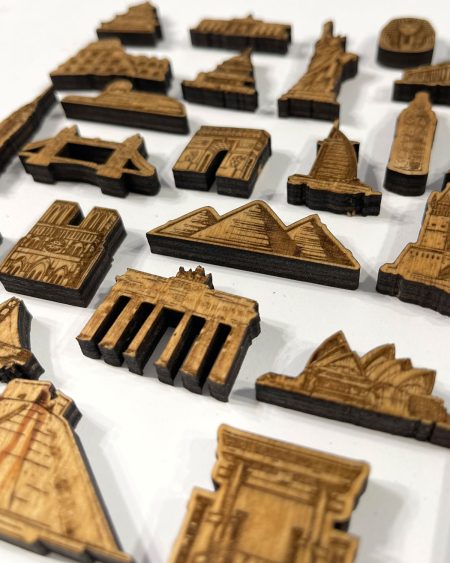


What materials are needed to mark visited places?
To mark visited places, you primarily need the right markers and, depending on the chosen method, additional helpful materials. For classic maps, you’ll need pushpins in different colors or with country flags. We recommend special markers that can be mounted safely without damaging the surface.
At Sikorka, we offer complete starter sets that include all the necessary elements:
- Colorful pushpins or markers
- Route markers
- Themed stickers
- Mini photo frames to place next to the map
- An instruction guide with creative ideas
Our experience shows that it’s worth investing in high-quality materials that won’t discolor over time and will keep an attractive look for years. We especially recommend metal markers with an epoxy coating, which are resistant to UV rays and won’t fade even when exposed to direct sunlight.
Creative map designs used as a travel journal
In this section, we present inspiring ideas for non-standard travel maps that can become a central feature of your interior and a unique record of personal experiences.
Personalized maps
A DIY world map is a concept that’s gaining popularity among creative travelers. At Sikorka, we offer basic map templates that you can adjust on your own to suit your needs and aesthetic preferences.
Personalization may include:
- Choosing a color palette to match the interior
- Adding personal text and dates
- Marking special places (e.g., an engagement location, honeymoon month)
- Modifying the map’s proportions to highlight the regions you visit most often
Our customers often choose maps with an engraved travel motif or a quote that accompanies them during their journeys. Such personalization makes the map truly a personal item.
Themed maps
Themed maps focus on a specific aspect of traveling that is particularly close to the owner. They can be food maps highlighting places where local specialties can be tasted, climbing maps with marked peaks, or diving maps with marked reefs.
We can prepare personalized proposals for fans of, among other things:
- Winemaking (with marked wine regions)
- Winter sports (with marked ski resorts)
- National parks
- Music festivals
- Historical architecture
This themed approach makes it possible to reflect personal passions and interests more deeply in the form of a decorative map.
Regional vs. global maps
The choice between a regional and a global map depends on the nature of your travels and your personal preferences. Globe-trotters visiting different continents will appreciate the classic world map, while people focusing on exploring a specific region may prefer more detailed local maps.
A compelling solution is modular maps, where the central element is a world map, and around it you can place more detailed maps of regions you visit most often. This collection grows along with travel experiences.
How to combine a map with other travel keepsakes?
To combine a map with other travel keepsakes, it’s worth creating a cohesive themed wall arrangement, where the map is the central element surrounded by photos, objects, and other memorabilia. At Sikorka, we recommend creating so-called memory walls, where other keepsakes are grouped around the map in a thoughtful, aesthetic way.
A practical solution is to place shelves or display cases around the map for small items brought back from your trips—local crafts, distinctive objects, or tickets to tourist attractions. It’s also worth considering link systems or grids on which you can hang travel photos near the corresponding places on the map.
Our customers often choose modular solutions, where the map is the central element of the composition, and around it, as they take more trips, additional elements with new keepsakes and memories are added.
Additional elements of a travel journal
In this section, we’ll discuss how to expand the travel map concept with additional elements—creating a comprehensive memory documentation system, from photos and notes to collections of keepsakes.
Combining the map with a photo album
Integrating a map with photographs is a natural way to enhance the travel journal. At Sikorka, we offer special systems that connect the map with miniature photo frames that can be placed directly next to the marked locations.
For traditionalists, we recommend a set consisting of a map and a stylistically matched album, where photos can be captioned and organized according to the trips taken.
Travel notes next to the map
Documenting trips takes on a deeper dimension when—besides visual memories—we also add notes and descriptions. Wooden markers with space for a date and a short description of the most important memory from a given place are also popular. This note format is concise, yet it still helps capture the essence of the experience.
Collecting keepsakes
Small travel keepsakes can be an integral part of a trip documentation system. At Sikorka, we design special display cases and shelves that can be mounted near the map, creating a cohesive arrangement.
Especially effective are:
- Collections of coins and banknotes from visited countries
- Tickets to tourist attractions
- Miniature souvenirs
- Samples of sand or stones from exceptional beaches and mountains
For advanced collectors, we offer labeling and description systems that help preserve information about their origin and meaning.
Which maps are the most durable and most aesthetically pleasing?
The most durable and most aesthetically pleasing maps are made from high-quality natural wood, with precise laser engraving and proper surface protection. At Sikorka, we specialize in exactly such maps that combine exceptional aesthetics with durability measured in decades.
Many years of experience in producing wooden maps have allowed us to select the best types of wood for this purpose:
| Type of wood | Durability | Aesthetics | Special features |
| Oak | Very high | Distinct wood grain pattern | Gains nobility with age |
| Walnut | High | Dark, elegant shade | Ideal for classic interiors |
| Birch | Medium | Light, fresh color | Takes dyes well |
| Maple | High | Uniform structure | Perfect for precise engravings |
Our maps are protected with natural oils that highlight the beauty of the wood while protecting it from moisture and dirt. Unlike varnishes, this finish allows the wood to “breathe” and preserves its natural character.
The map’s durability is also influenced by manufacturing precision—our products are engraved with accuracy to 0.1 mm, ensuring a clear reproduction even of the smallest geographic details.
How to document travels on a map with children?
The best way to document travels on a map with children is to create an interactive and educational system that engages the youngest in the process of marking and telling stories about visited places. At Sikorka, we developed special family maps tailored to the needs of the youngest travelers.
Key elements of successful travel documentation with children include:
- Colorful, safe markers—we use rounded pushpins or magnetic elements.
- A rewards system for visited places—special achievement stickers (“First flight,” “First mountain,” “First sea”).
- A simplified legend with illustrations instead of text.
- Additional educational elements—interesting facts about countries, animals, or culture.
A solution tested by our company is the “Little Explorer Map,” where children can not only mark places, but also learn about the geography, culture, and nature of the visited regions.
Engaging children in documenting travel develops their geographic skills, builds a sense of belonging to family stories, and encourages curiosity about the world. Our customers often emphasize how the map becomes a pretext for family conversations and planning new adventures. Our experience shows that wooden maps are an ideal wall decoration for a child’s room.
What creative ways of marking places can you use?
Creative ways of marking places on a map include personalized themed markers, color-coding systems, chronological markings with dates, as well as interactive elements with hidden information. At Sikorka, we observe a growing popularity of non-standard solutions that make the map truly a personal travel journal.
Especially interesting are systems that allow you to code more information than just the fact that a place was visited:
- Different pushpin colors for different types of trips (vacations, business trips, weekend excursions)
- Symbols representing activities (skiing, diving, sightseeing historic sights)
- A color gradient showing the chronology of trips
- Miniature flags for particularly memorable places
Our customers often share their creative ideas—from creating routes with colored threads connecting visited places to placing small elements brought back from trips (e.g., sand grains from a desert in small vials attached to the map).
Another popular solution is QR code stickers that, once scanned, open a photo album, a video clip, or notes about that place. It’s an elegant combination of a physical map with digital memories.
How to use a map as a motivational element for planning your next trips?
A map can be used as a motivational element for planning your next trips by creating a system for visualizing travel goals, a list of places to visit, and tracking progress in fulfilling travel dreams. At Sikorka, we noticed that maps serve not only a documentation function, but also an inspirational one.
An effective strategy is to mark places you’ve already visited in one color and places you plan to visit in another. Such a visual representation of “blank spots” on a personal travel map naturally encourages you to fill them in.
You can also create a system of travel priorities:
- “Must-see” places marked with red markers
- Secondary travel goals marked with yellow markers
- Travel dreams marked with blue markers
Many of our customers use the map as the center of their planning, placing notes around it with information about dream destinations, the best times of year to visit, or estimated costs.
Some also create “travel challenges”—for example, visiting all national parks in a given country or reaching the farthest points of each continent. In that case, the map becomes a visual record of progress in carrying out those challenges.
Summary
A wooden world map for the wall is much more than just a decorative item—it’s a personal travel journal, inspiration for planning your next adventures, and a constant source of memories. In the article, we presented various types of maps, ways to mark them, and methods for combining them with other travel documentation elements.
Sikorka, as a specialist in producing wooden maps, offers a wide selection of products tailored to different needs and preferences of travelers. Our maps are characterized by the highest workmanship quality, durability, and aesthetics that harmoniously match various interior styles.
We encourage you to visit our site www.sikorka.jdmsite.com, where you will find a full range of world, continent, country, and city maps, as well as accessories for marking them.


